The
first thing I want to say is that I'm not licensed
or certified personal trainer. Personal experience
has been my education. Consult a physician before
starting any exercise routine.
Like a lot of people out there, I'm a fitness and
exercise enthusiast. I've been working out since my
high school football days. When football was over, I
kept eating the same and became fat. I'm a shade
over 6 feet tall and at my most I weighed 253
pounds. After high school I knew I had to loose
weight and get in shape. I've tried and read a lot
of different workouts, exercises and diets. I lost
weight the right way. It took me almost two years,
but I went from 253 to 178. A big difference for
sure. I did that over my freshman and sophomore
years of college. During that time I was also trying
to, "Get Huge," muscularly. Try as I might I just
wasn't getting big like Arnold. While I made some
gains, I came to realize what truly decided the
muscular disposition of a person. That thing is the,
"G-word," Genetics. While anybody can improve on
what they have, one just has to be realistic with
what they'll end up with. For me, I knew even if
worked as hard and as long as anybody, I wasn't
going to, "Get Huge." Towards the end of my
sophomore year, I was introduced to Wing Chun. And
that started to change the way I looked at
everything. As I started my Wing Chun training, it
really made me take an honest look at was really
worth while about working out. What was practical,
efficient and functional? Enough with the history,
let's get started on the tetrahedron of fitness.
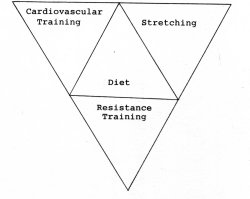
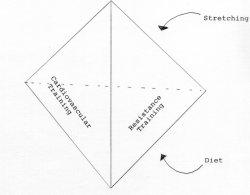
First of all, what the heck is a tetrahedron? It's a
four-sided pyramid. When trying to picture it, think
of a three-sided pyramid, but now include the bottom
of it and that makes four. If you've ever seen a
four sided dice that's exactly what it is. The
prefix, "Tetra," is Greek for four. The four sides
of the tetrahedron are cardiovascular training,
resistance training, stretching, and diet. To
achieve true total fitness each side is as equally
important as any other side is.
The first side I'll talk about is the cardiovascular
side. This is my favorite aspect of the fitness
tetrahedron. Simply put cardiovascular fitness means
to raise ones heart rate so the heart will be
exercised and eventually pump more efficiently. The
limiting factor in exercise is cardiac output.
Cardiac output is the combination of one's heart
rate plus one's stroke volume. Stroke volume is the
amount of blood pumped out of the heart during a
heart contraction. Of these two things, heart rate
and stroke volume, to increase one's stroke volume
is the more effective way to increase one's
cardiovascular ability. Why is this? Because if you
get more blood to circulate with better stokes of
the heart, you'll have more oxygen moving around the
body. But to increase one's stroke volume, you have
to increase your heart rate. There is a but, and
that is you need to increase your heart rate to an
efficient level. What is that efficient level? That
level is between 60% and 80% of your maximum heart
rate. To find your maximum heart rate you simply
subtract your age from 220 and then multiple by 0.6
and 0.8 to find your 60% and 80% heart rate. Why
these percentages? If you go under 60% you won't be
increasing your heart rate enough to get an
effective workout. If you go over this, your heart
will be pumping to fast to efficiently circulate
enough oxygen to the body. If you can stay closer to
80% that's great, but your workout can vary
depending how you feel that day. Just as long as you
stay between 60% and 80%, you'll have an effective
and efficient workout.
That's
enough of a physiology lesson for now, let's get to
the fun part. What exercises should one do to get a
good cardiovascular workout? Basically any will do,
but there are a few that are more effective at
getting your heart rate up faster and keeping it
there better than others. The easy ones at doing
this are running/jogging, swimming, cross country
skiing, jump roping and the gauntlet Stairmaster are
some of my favorites. When the whether gets warm,
running outside, running hills, biking, hiking with
a good load of weight are others that I love to do.
Other good cardiovascular workouts include aerobic
classes, Tae Bo, and Tai kwon do. If you're worried
about impact on your knee's, biking, hiking,
swimming, and cross-country skiing are great ones.
Running in the swimming pool is another great low
impact exercise. Basically, choose what you like to
do from day to day, it doesn't matter, as long as
you do something.
How
long and how often should one do cardiovascular
training? 4 to 6 days a week for 20 to 30 minutes a
day is all need to improve your fitness. Unless
you're training for a marathon, 20 to 30 minutes, 4
to 6 days a week in that target heart range will be
more than enough. Also, start doing things like
taking the stairs instead of elevators. Park your
car further away, so you walk a little further. That
way you're incorporating fitness into your daily
life. Give it a couple of weeks and you'll not only
not get winded when you climb those stairs, you'll
feel great.
The next side of the tetrahedron I'm going to talk
about is the resistance training. Just briefly I'm
going to talk about the mechanics of muscle
contraction. Contraction – the active process of
generating a force on a muscle
Tension
– the force exerted by a contracting muscle on an
object
Load
– force exerted on a muscle by the weight of an
object.
There are three types of muscle contractions
Isotonic
– the length of the muscle shortens, tension is
constant.
An
example of this would be to lift a load, or even
body movement.
Isometric
– muscle length is constant, but tension increases
An
example of this would be a load greater than tension
produced, Supporting the body in a fixed position is
an example of this.
Eccentric
(lengthening) - this occurs when an unsupported load
on a muscle is Greater than the tension generated.
This occurs when an object supported by a muscle is
lowered. Such as sitting down from a standing
position
Enough
with the physiology already. The crux of this is to
do some type of strength/resistance training. What
to do? Like I was saying, I like to do what is
practical, efficient and functional. Shortly after I
got into Wing Chun, I also got into rock climbing
and that really helped change my perspective. Doing
lat pull downs weren't going to help me get to the
top of the wall. Doing a workout that simulated the
task I was going to do was really going to help me.
Personally I like compound movements. Those are
movements that involve multiple muscle groups at the
same time. You get more bang for your buck and it's
a time saver because instead of doing separate
exercises for biceps, back, and rear deltoid; I
would do pull ups. In stead of doing separate
exercises for pecks, triceps, and front deltoids; I
would dips or a form of push up. If you can't do a
dip or pull up, many gyms have a pull up/dip assist
machine. These are great things to do to build up
your strength so you'll be able to do unassisted
pull-ups and dips. A realistic resistance/strength
training routine shouldn't take more than 20 to 30
minutes. Keep the repetition range at ten. And only
rest 1 to 2 minutes between sets. Start out easy and
work your way up. You're in this for the long term,
not the short term. A sample beginning exercise
program could be three sets of pull-ups (palms away
from the body), three sets of dips, two sets of
chin-ups (palms toward the body), and finish with
two sets of push-ups. For abdominal, start with two
sets of crunches. What about legs? You'll get that
when you do your cardio workout. Simple right?
Unless you're training for a power-lifting contest I
don't believe you need to try to push insane amounts
of iron. 2 to 3 times a week will provide you with
positive results. Try to give a day or two rest
in-between workouts. Remember if something starts to
hurt you, stop what you're doing and consider
seeking medical attention.
The next part of the tetrahedron is stretching.
Stretching improves health and fitness. Stretching
also reduces the risk of injury. Lots of times
everyday injuries happen by overextending a joint,
muscle, and connective tissue. These overextensions
can result in muscle pulls, strains and sprains. The
difference between a strain and a sprain is a strain
is an overextension of a muscle, a sprain involves
an overextension of tendon and/or ligaments. In
martial arts flexibility is a premium.
Stretching
is a great way to warm up and cool down before and
after a workout. It feels great to stretch after a
workout. It will help one prevent soreness after
working out and promote faster recovery. No one
wants to be tight, especially a martial artist.
Stretching will help alleviate that tightness.
What,
when and how to stretch? What to stretch would be
all the muscles and body parts you can. When,
stretch early and stretch often. Try to hold each
stretch for 20 to 30 seconds. After a workout you
should realistically allocate 15 to 20 minutes to
stretching. Stretching is as important as any other
component and it's the one that is done the least.
Stretching should be enjoyable. Go to the local
bookstore and get any good yoga or stretching basics
book, or read Sifu Ed Basile's article on stretching
to get some ideas.
A
thing to remember is not to bounce. This can injure
your muscle and then you'll be going backwards
instead of forwards in your fitness goals. Ease into
the stretch. Just like with the other components,
stretching will be a progressive thing. Give it a
chance, it will be to your benefit.
The final component in the tetrahedron of fitness is
the diet. People think this is the easiest to
change, but it might possible be the hardest. Why?
Because people love to eat, not only for necessity,
but because there's a lot of good tasting food out
there. I'm not going to go to in-depth about eating
habits, because a lot of it is common sense. Let's
start with things that are not healthy to eat. All
fast food places should be avoided. Even Subway? If
you get one of there low calorie subs that could be
acceptable. Going out to eat in general in my
opinion isn't to great for you. You just don't know
what that restaurant is adding to your food. I'm not
saying never go out to eat, but try to keep down to
once or twice a week. It's the everyday eating that
you run into trouble. To stay fit one needs to eat
none calorie dense foods. Surprise, these foods
would be your everyday fruit and vegetables. For
protein stick with egg whites, skinless chicken,
tuna. Those are some of my favorites. If you eat
salads, don't add dressing, or else you're defeating
the whole purpose.
Here's a list of foods that's easy to stock your
house with
Everything
for Energy
Simple Carbohydrates – apples, banana's, berries,
cantaloupe, cherries, grapefruit,
Oranges, pineapples, plums and watermelon.
?Starchy? Complex Carbohydrates – Barley, oatmeal,
rice, squash, sweet potatoes,
Yams, whole grain breads, bagels, cereals, pastas
And pancakes.
Legume Carbohydrates – black eyed peas, black
beans, kidney beans lima beans, lentils
Pinto beans read beans, navy beans
A good way to estimate the portion size you should
have is an amount equal to two handfuls. Limit
yourself to 2 to 3 portions of carbohydrates a day
and try to have them between 6am to noon. This is
because carbohydrates are the body's fuels. You need
to fill up your tank to start your day. If you can,
taper off around noon. What carbohydrates you don't
use for energy get turned into fat. So if you have a
regular healthy metabolism like me, you can get all
the carbohydrates you need before noon. Why complex
carbohydrates, because they stay in your system
longer than simple carbohydrates do.
Everything to Build
Protein sources – albacore, skinless white chicken
breasts, cod, egg whites, orange roughy, Shrimp,
tuna (fresh or water packed if canned), non/low fat
yogurt/milk/Cottage cheese
A good way I estimate how much protein to have is
0.5 grams of protein for every body pound I weigh.
This is a good amount. With out getting into more
physiology, too much protein can be hard on the
kidneys.
Everything Else
High
fiber vegetables – alfalfa sprouts, asparagus,
bean sprouts, broccoli, cabbage,
Carrots, cauliflower, celery, green beans, lettuce,
mushrooms, Onions, celery, cucumbers, eggplant,
peppers, spinach and zucchini
Sweet things (all should be sugar free and fat free)
Cinnamon sticks, cocoa (Swiss miss items), gum,
Jell-O, nutra sweet, Popsicle's, Pudding, slushies,
vanilla extract
Beverages
Flavored Water, low sodium bouillon, coffee, diet
soda, teas, vegetable juice
Condiments
All spices (salt free), fat-free mayonnaise,
fat-free dressings, garlic, herbs, lemon
Juice, mustards, peppers and vinegar.
You can eat as much in the, ?Everything else,?
category you want at any one time. Just try to have
high fiber vegetables with all your meals.
A final few things on nutrition
-it's ok to have the occasional fast food, candy
bar, etc, it's when it's an everyday/every meal
event that you'll have trouble maintaining health
-Drink plenty of water, 8 glasses a day, at least.
The body is 60% water; you need to stay hydrated.
-Try to eat smaller meals, 4 to 6 a day, I know this
is hard sometimes, but it's easier on the digestive
system
-Stay away from full fat cheeses, butters, and
margarine's, nuts and seeds, full sugar jams and
jellies, whole milk, whole eggs, sandwich meats,
cookies/candy, cakes, chips, microwave popcorn,
fruit drink (not juices, drinks), carbohydrate
drinks, dried fruit (they're high in sugar), canned
vegetables (frozen are ok), ice cream, pork, syrup,
full fat mayonnaise, dark meat poultry, alcohol,
fast foods.
-Try not to eat 4 hours before going to sleep
-Try to workout in the morning if possible. This way
you'll be burning your calorie reserves.
-Don't keep bad foods in your house. If there's no
temptation, there'll be no overindulgence.
What about olive oil? Isn't that good for you?
Well, yes and no. Yes, because you do need fat in
your diet. Two tablespoons a day is enough. I use an
arousal pump sprayer. You put the oil in, pump it up
and spray it out. I use it for lubricating pans or
to lightly put oil on food. The No part is because
olive oil is fat, and you'll get plenty of fat,
protein and carbohydrates in a well balanced diet.
What about vitamins and supplements?
When I was in college at the University of Illinois at
Chicago, one of the nutrition classes was taught me
the truth about vitamins and supplements. The
professor of the class had a PHD in biochemistry. He
taught biochemistry in Germany to German medical
students (he's an American who speaks German). He
worked for the RDA for seven years. He led an
expedition to Mt Everest to study the effects of how
the body burned calories at different altitudes. In
other words, he knows his stuff. I asked him this
very question. From all his research and
understanding he said that with a proper diet, the
only item that might be needed is a multivitamin.
That's it, a single multivitamin a day was all he
said people needed. Eat healthy and you'll be fine.
Nutrition isn't hard it's just common sense. Eating
right can be hard the hardest part, but it's
important.
Well, that's it. That's my tetrahedron of fitness.
Four aspects of fitness that will make you a
healthier person. If you've made it this far and
have any questions please write to me at Ken@windycitywingchun.com
. Train well and train safe.